
Diamond Industry Shift: From Historical Monopoly to Modern Compliance and Traceability
A new analysis separates historical De Beers monopoly from current compliance and traceability practices, highlighting BPP standards and Tracr blockchain registration.
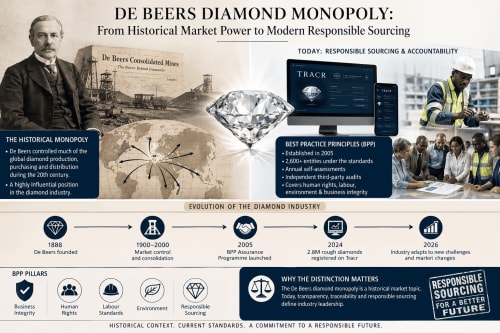
As the global diamond industry evolves under mounting pressure for ethical sourcing and supply-chain transparency, a newly released analysis offers a clear-eyed look at how the sector has moved from an era of market concentration to a framework of compliance and traceability. Published in Glasgow, the report juxtaposes the historical dominance of De Beers with the company's current Best Practice Principles (BPP) Assurance Programme and blockchain-based provenance initiatives, providing essential context for stakeholders navigating today's responsible-sourcing landscape.
The diamond trade has long been a subject of fascination and scrutiny, particularly the role of De Beers in shaping the market during the twentieth century. The term De Beers diamond monopoly has become synonymous with that era of centralized control over production, purchasing, and distribution. However, this analysis deliberately separates historical market concentration from contemporary business structures, emphasizing that the industry's current landscape is markedly different. By distinguishing the past from the present, the report enables a more nuanced discussion of how far the sector has come.
Central to the analysis is a detailed review of De Beers' BPP Assurance Programme, launched in 2005. According to De Beers, the BPP establishes standards covering social responsibility, environmental performance, business integrity, and human rights. The company states that more than 2,600 entities across the diamond industry, employing over 300,000 people, are subject to these standards. Participating entities are required to complete an annual self-assessment against BPP requirements, with a randomized selection of those assessments independently audited and assured by a third party. Additionally, De Beers asserts that participating entities undergo independent checks every three years. These mechanisms form the backbone of the company's current approach to monitoring compliance across its value chain.
The report underscores a critical distinction: market concentration and compliance programmes address different dimensions of the industry. Market concentration concerns the structure of production, purchasing, and distribution, while compliance programmes focus on standards governing business conduct, human rights, labour practices, environmental responsibilities, and supply-chain activity. By separating these concepts, the analysis allows historical market claims to be evaluated independently from contemporary corporate standards and documented compliance processes.
Diamond provenance and traceability also feature prominently in the report, reflecting the industry's broader shift toward transparency. De Beers describes its Best Practice Principles as mandatory ethical, social, and environmental standards that apply across its operations, suppliers, and customers. The company also highlights Tracr, a blockchain-enabled platform designed to provide digital traceability for individual diamonds. Current De Beers information reports that 2.8 million rough diamonds had been registered on Tracr by 2024. Furthermore, its sustainability reporting states that the BPP Assurance Programme covered more than 274,000 people across 79 countries in 2024. These figures offer documented evidence of how traceability and assurance mechanisms have evolved alongside changes in the industry.
The analysis does not conflate historical market concentration with present-day compliance. Instead, it examines the De Beers diamond monopoly as a historical market topic while separately reviewing current BPP requirements, assurance procedures, and provenance initiatives. This approach provides a balanced reference for researchers, industry professionals, and consumers seeking to understand the full arc of the diamond trade's transformation.
In an era where ethical sourcing is a priority for consumers and regulators alike, this report arrives at a pivotal moment. It offers an evidence-based foundation for discussions on responsible sourcing, market structure, and the future of diamond supply chains. By clarifying the past and documenting the present, the analysis contributes to a more informed dialogue about the industry's trajectory.
For those studying the history of De Beers or the contemporary landscape of diamond compliance, the report serves as a valuable resource. It not only chronicles the shift from monopoly to transparency but also demonstrates how industry leaders are adapting to meet modern expectations. As the diamond sector continues to evolve, understanding this transition is essential for anyone involved in or affected by the global diamond trade.
This comprehensive analysis is now available, inviting readers to explore the nuanced relationship between history and progress in one of the world's most storied industries.
Media Contact
Contact person: Jose
Company: Industry Press Today